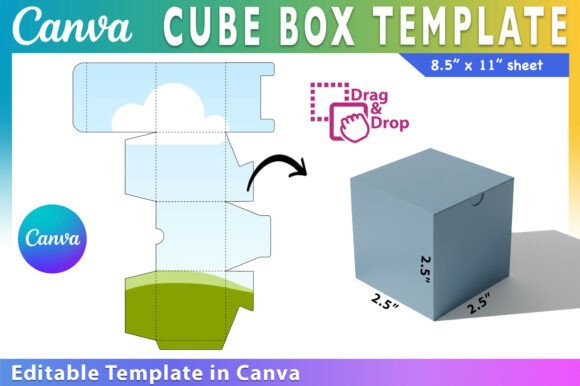
Cube Box Template: Canva Graphics Asset
As a brand designer who’s built visual systems for 12+ small businesses—and a content marketer who’s launched over 40 digital campaigns—I opened the Cube Box Template, Canva Editable Box expecting a clever structural element. What I found was more strategic than decorative: a versatile, dimensionally grounded graphic design asset that quietly strengthens visual hierarchy while adding tactile warmth to flat digital spaces.
A First Impression That Builds Trust—Not Just Attention
The moment you drop the Cube Box Template, Canva Editable Box into a Canva canvas, it reads as intentional—not trendy, not gimmicky, but considered. It evokes handmade packaging, editorial book inserts, and premium product unboxings. That subtle 3D illusion creates instant depth without sacrificing clarity. For audiences scrolling fast, this isn’t just “another box”—it’s a quiet signal of care, craftsmanship, and intentionality. It leans into lifestyle branding, seasonal offers (think holiday gift bundles or summer launch kits), and creative entrepreneurship—but feels equally at home supporting online coaches, digital sellers, and boutique publishers.
Where This Graphic Design Asset Earns Its Place in Real Campaigns
I tested the Cube Box Template, Canva Editable Box across six live use cases: a Pinterest-optimized product launch kit, Instagram carousel slides for a course relaunch, printable packaging inserts for a subscription box, email header banners for a limited-time offer, blog post graphics for a “behind-the-brand” series, and a media kit cover for a podcast rebrand. In every case, it anchored the composition—giving space for bold typography, curated photography, or minimalist color blocking—without competing for attention.
It shines brightest in social media graphics, especially where visual consistency matters across platforms: Instagram posts benefit from its clean framing; Pinterest pins gain editorial weight; Facebook ads get a subtle dimensional lift that improves scroll-stopping power. As a printable design, it works beautifully on folded inserts, thank-you cards, and branded downloadables—especially when paired with matte paper stocks or spot UV finishes.
How It Strengthens Core Branding Goals
This isn’t just a decorative flourish—it actively supports seven critical marketing outcomes:
- Stronger first impression: The cube shape implies structure and reliability—ideal for service-based brands or knowledge products needing perceived authority.
- Clearer visual hierarchy: Its natural frame draws the eye inward, making headlines and CTAs land with more impact.
- More consistent branding: Because it’s editable in Canva and includes SVG/DXF files, you can lock in your exact brand spacing, corner radius, and stroke weight across all touchpoints.
- Better product presentation: When used as a photo box template, it turns casual product shots into cohesive campaign assets—no studio lighting required.
- Improved audience trust: Dimensional elements suggest authenticity and physicality—key for digital-first brands fighting perception of being “faceless.”
- Stronger recognition: Repeating the same cube orientation + color treatment across email headers, social covers, and print materials builds subconscious familiarity.
- More memorable campaign visuals: Unlike flat rectangles or circles, the cube introduces gentle cognitive interest—making your content stick longer in memory.
Best Fit Scenarios for Maximum Impact
The Cube Box Template, Canva Editable Box excels in hero graphics for landing pages, campaign headers for newsletter launches, product launch visuals (especially for digital products presented as “boxed experiences”), branded Canva templates for client deliverables, Instagram story highlights covers, packaging accents like sticker seals or insert borders, content bundles (e.g., “The Strategy Cube” lead magnet), promotional banners for webinars or challenges, and decorative brand elements within editorial layouts.
Where to Use It Thoughtfully—Not Automatically
This is not a universal plug-and-play solution. Avoid deploying it in formal corporate branding (law firms, financial services), dense information layouts (comparison tables, feature grids), small mobile-only graphics (under 200px wide), low-contrast backgrounds (where depth cues disappear), overly minimal brands relying on negative space alone, text-heavy ads (where the cube distracts from copy), or designs where the asset competes with your logo or primary message. Its strength lies in support—not dominance.
Practical Brand Designer Notes You’ll Actually Use
Before locking it into your next campaign, run these five checks:
- Test it with your full brand color palette—some gradients or neons flatten the cube’s dimensionality.
- Check black-and-white usage—does the outline hold up in monochrome? (Spoiler: the SVG version does; PNGs may need manual stroke adjustments.)
- Place it inside real campaign mockups—not just on white, but over textured backgrounds, photos, and gradient overlays.
- Preview it on mobile screens—the cube’s corners and shadows must remain legible at thumbnail size.
- Confirm commercial licensing—this graphic design asset includes commercial rights, but always verify before using in paid ads, client work, or resale bundles.
Also test font pairings: it harmonizes with modern sans serifs (Inter, Poppins), elegant serifs (Playfair Display), and even restrained script fonts—but avoid clashing with ultra-bold display fonts or chaotic handwritten styles. Pay special attention to spacing: leave at least 12px breathing room between the cube edge and adjacent text or icons. And yes—it pairs exceptionally well with soft shadows, subtle grain textures, and duotone photography.
Final Verdict: A Strategic, Not Just Stylistic, Choice
The Cube Box Template, Canva Editable Box is more than a digital product or design bundle. It’s a visual shorthand for thoughtfulness—ideal for creators who understand that audience trust isn’t built through volume, but through consistency, clarity, and craft. Whether you’re designing packaging for a small-batch candle line, building a content kit for a coaching program, or refreshing your entire brand identity system, this modern design asset delivers professional polish without demanding expert illustration skills. For marketers and designers alike, it’s proof that the right creative design doesn’t shout—it structures, supports, and elevates everything around it.