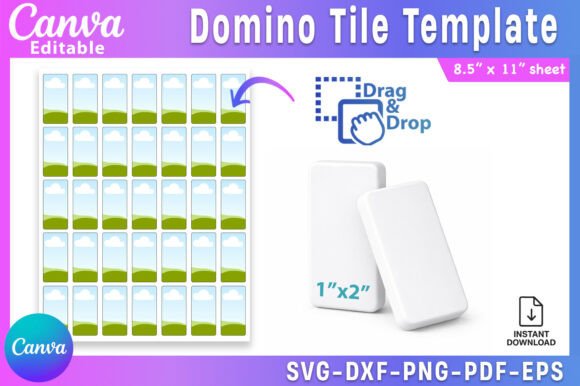
Domino Tile Template SVG for Canva Graphics
As a digital product creator who’s launched over 200 Etsy listings and managed seasonal collections across Creative Fabrica, Shopify, and print-on-demand platforms, I tested the Domino Tile Template SVG, Canva Domino with one goal: does it hold up as a flexible, commercially viable graphic design asset? Not just for fun — but for real products that sell.
First impression? Clean, approachable, and quietly versatile. The round-cornered tile shape reads modern yet timeless — not overly playful or too clinical. It lands somewhere between minimalist and handmade: soft edges, balanced proportions, and subtle visual weight. That makes it ideal for audiences drawn to thoughtful design — think small business branding, nursery decor, planner communities, or wellness-focused content creators. It doesn’t scream “festive” or “vintage,” so it won’t clash in evergreen bundles — a major plus when building cohesive digital download shops.
I used the Domino Tile Template SVG, Canva Domino across six real product scenarios before finalizing any listing:
- SVG-based sticker sheets — imported into Cricut Design Space and Silhouette Studio; cut lines were crisp and consistent at 3" and 5" sizes
- Printable wall art sets — layered with serif and sans serif typography in Canva; the rounded corners softened contrast without sacrificing readability
- Tote bag & mug designs — scaled and centered on sublimation mockups; held detail well even at 8" width
- Canva template kits — embedded as editable frames in branded social media templates (Instagram carousels, Pinterest pins)
- Digital paper packs — repeated as seamless patterns in Procreate and Illustrator; spacing worked naturally for scrapbooking and planner inserts
- Greeting card bundles — paired with handwritten fonts and soft watercolor textures; added warmth without overwhelming the layout
Where this graphic design asset shines is in product presentation. Because the domino tile shape creates natural framing, it boosts perceived value in thumbnails — especially on Etsy and Creative Fabrica, where scroll speed is high. I dropped it into three different mockup scenes: a flat-lay of printable stickers on kraft paper, a ceramic mug shot with soft shadowing, and a Canva template preview showing editable layers. In all cases, the tile acted as a visual anchor — guiding attention, supporting visual hierarchy, and reinforcing brand consistency across collections.
The Domino Tile Template SVG, Canva Domino works best in contexts where clarity, scalability, and gentle structure matter: large-format printable designs, themed bundles (like “Back-to-School Planners” or “Small Business Brand Kits”), decorative layouts for blogs or newsletters, merchandise graphics with breathing room, and social media promos where clean composition increases click-through potential.
That said, use it carefully in these situations:
- Sticker sheets requiring ultra-fine interior details — the rounded corners soften tight negative space, so avoid pairing it with intricate line art inside the tile
- Crowded thumbnails under 400px wide — the shape loses definition if scaled too small without supporting text or color contrast
- Dark-background packaging or merch — test contrast first; some versions lack bold outlines, so light-colored tiles may fade without a subtle stroke or drop shadow
- Text-heavy Canva templates — it’s a frame, not a background; avoid stacking dense paragraphs directly inside unless you add generous padding or a semi-transparent overlay
- Cricut projects demanding precision cutting on thin vinyl — always inspect the SVG path in Design Space before sending to cut; verify no stray anchor points or compound paths
Here are my practical seller notes — the kind I wish I’d had before uploading my first bundle:
- Test the design on at least two mockups: one light (white mug, paper background) and one dark (black tumbler, navy digital paper)
- Preview your final listing thumbnail at 300px width — does the tile still read clearly?
- Check PNG transparency in Photoshop or GIMP — ensure no hidden white fill or anti-aliasing fringes
- Verify SVG file integrity: open in a vector editor, ungroup layers, and confirm all strokes are outlined or properly set to hairline weight
- Organize customer files logically — label folders like “SVG_Cricut,” “PNG_300dpi,” “Canva_Template_Link” — clarity builds trust
- Pair it intentionally: try it with Montserrat (clean), Playfair Display (elegant), Pacifico (handwritten), and Oswald (bold display) to see which voice fits your niche
- Confirm commercial license terms — this is an instant digital download (no physical item shipped), delivered via PDF with Canva access link; ensure redistribution rights align with your end-use
This isn’t a “one-size-fits-all” illustration — it’s a purpose-built graphic design asset. Its strength lies in how easily it integrates into workflows: from turning a Canva template into a premium digital product, to anchoring a sublimation design for a POD store, to adding cohesion across a printable sticker bundle. For Etsy sellers building authority in planner or education niches, for Cricut users launching seasonal craft kits, or for designers curating brand-aligned social media graphics — the Domino Tile Template SVG, Canva Domino delivers quiet professionalism without demanding attention.
If you’re evaluating assets for your next collection, ask: does it scale across formats? Does it support — not compete with — your typography and color system? Does it feel intentional, not incidental? The Domino Tile Template SVG, Canva Domino passes all three. It won’t go viral on its own — but it will help your digital product look polished, trustworthy, and thoughtfully built. And in online selling, that’s often the difference between a browse and a buy.