Business Card Canva Template: Modern Graphics for Sellers
As a digital product creator who’s launched over 200 listings across Etsy, Creative Market, and Shopify—mostly Canva templates, SVG bundles, and printable design assets—I tested the Business Card Canva Template last week while building a new “Minimal Brand Starter Kit” for small business owners. My goal wasn’t just to use it—I needed to know whether it would hold up as a commercial design asset across real selling scenarios: print-on-demand business cards, Cricut-cut vinyl stickers, sublimation-ready mug wraps, and bundled digital downloads.
First Impression: Clean, Confident, Commercial-Ready
The Business Card Canva Template delivers exactly what its title promises: a modern minimal aesthetic with strong visual hierarchy. It’s not playful or whimsical—it leans into quiet confidence. Think crisp sans serif typography, generous white space, balanced front-and-back layout alignment, and subtle tonal contrast rather than bold color blocking. This makes it ideal for service-based entrepreneurs (coaches, consultants, therapists), boutique studios, and minimalist lifestyle brands—not so much for kids’ parties or craft fairs.
What stood out immediately was how well it translated across formats. I opened the Canva link (delivered via clean PDF instructions), duplicated the template, and swapped in placeholder text and a neutral logo. Within 90 seconds, I had a polished mockup ready for my product listing. No font licensing surprises, no missing layers—just editable fields that behave predictably in Canva’s editor.
Where This Graphic Design Asset Adds Real Value
This isn’t just a one-off printable—it’s a flexible commercial design that scales intelligently:
- SVG & PNG products: Exported the front and back as high-res PNGs (300 DPI) and vectorized key elements in Illustrator for clean SVG cut files—perfect for Cricut projects like branded sticker sheets or vinyl business card holders.
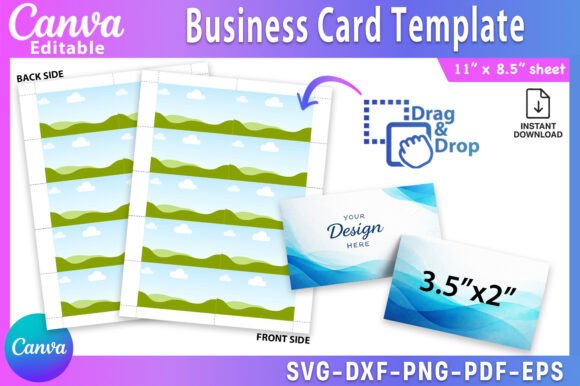
- Print-on-demand integration: Used the layout dimensions (3.5" x 2") to build matching card designs on Printful and Gelato. The minimal grid made resizing for alternate formats (e.g., square Instagram cards or folded mini flyers) straightforward.
- Bundling potential: Paired it with matching letterhead, social media banner, and email signature templates—all using the same spacing system and font pairings. That consistency boosts perceived value in design bundles.
- Merchandise expansion: Repurposed the card’s clean border motif as a tumbler wrap frame and adapted the monogram-style initial treatment for enamel pin mockups.
- Social media graphics: Duplicated the Canva template into Instagram Story and Pinterest Pin canvases—keeping the same color palette and typographic rhythm for cohesive brand storytelling.
How It Strengthens Your Product Presentation
On Etsy or Creative Fabrica, thumbnail clarity is non-negotiable. The Business Card Canva Template shines here: its strong negative space and centered focal point read instantly—even at 200px wide. I dropped it into a branded mockup (white desk surface, soft shadow, subtle texture overlay), and the result looked premium without needing heavy filters.
It also supports better visual storytelling in listings. Instead of generic “business card” stock photos, I used the actual Canva file to generate three realistic variants: one with a wellness brand palette, another in muted clay tones for ceramicists, and a third with navy/gold for financial advisors. That variety signals flexibility—and builds customer trust before they even click “Add to Cart.”
Best Use Cases—and Where to Proceed With Caution
This graphic design asset works best when clarity, scalability, and professional tone are priorities:
- Large-format printable products (e.g., A4 business card sheets for home printing)
- Themed digital download collections (e.g., “Modern Studio Bundle” with matching invoice + thank-you card templates)
- Product mockups for Shopify or Gumroad landing pages
- Social media promos for creative marketplace launches
- Brand identity kits targeting solopreneurs and micro-agencies
Use carefully in these situations:
- Tiny sticker applications: The fine line weights and tight kerning don’t scale down below 1.5” without losing legibility.
- Dark background products: Some versions rely on light-on-dark contrast—always test your exported PNG against black or charcoal mockups.
- Cricut/Silhouette cutting: While the base layout is clean, avoid using decorative divider lines as cut paths—they’re often too thin or inconsistent for precise blade routing.
- Text-heavy variations: This template prioritizes breathing room—not dense information. Adding more than 3–4 lines per side compromises its minimal integrity.
Practical Seller Notes Before You List
Before publishing any product built from the Business Card Canva Template, I ran these checks:
- Test-print on both matte and glossy cardstock—verify color fidelity and bleed alignment.
- Preview the thumbnail at 150px width in Etsy’s mobile preview mode—does the logo and name still pop?
- Open the Canva file on mobile—confirm all editable fields remain accessible and intuitive for non-designer buyers.
- Export PNGs with transparent backgrounds and verify no stray pixels or anti-aliasing artifacts.
- Check licensing: this is a commercial-use Canva template—but confirm the included fonts and icons are cleared for resale in derivative products.
- Pair it thoughtfully: I matched it with Montserrat (sans serif), Playfair Display (serif), and Caveat (handwritten accent)—giving buyers typographic flexibility without clutter.
Bottom line? The Business Card Canva Template isn’t flashy—but it’s reliable, adaptable, and quietly professional. For sellers building cohesive digital product lines—or expanding into physical merchandise—the time saved on layout consistency pays off fast. It won’t replace custom illustration work, but as a foundational graphic design asset, it earns its place in any serious digital seller’s toolkit.